Warehouse Floor Coating Guide: How to Choose the Right Industrial Floor System
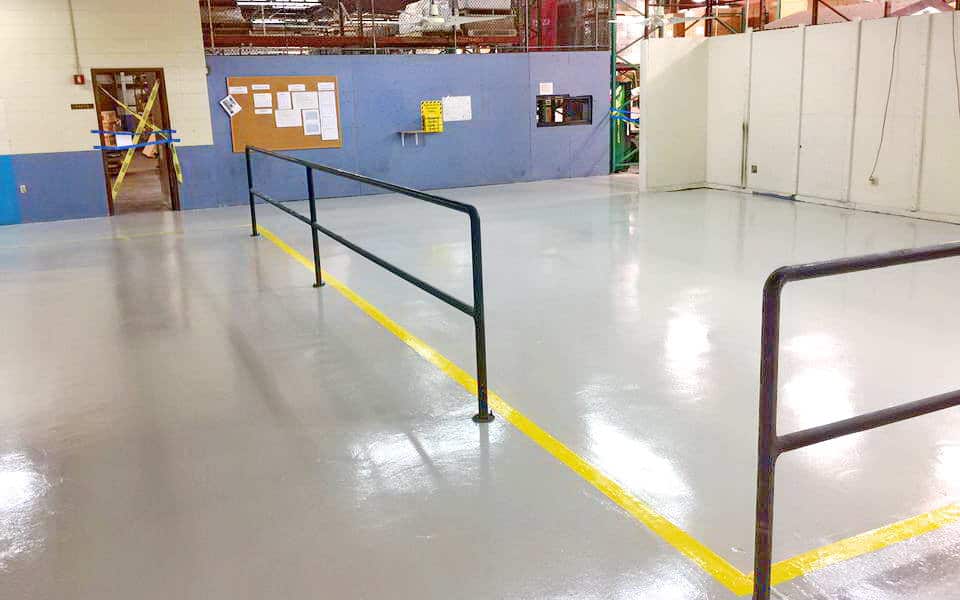
High-performance epoxy floor coating across an industrial warehouse at AMPORTS Jacksonville, installed by AI Coating
The floor at the JaxPort auto repair warehouse is 53,939 square feet. Before we put a drop of resin on it, we put moisture probes in it. The readings came back high, which is normal for a slab this close to the St. Johns River, and that one number decided the first coat: a moisture-control primer, not the standard one. Then a grout coat to fill the grinding profile, then a non-skid top coat because the techs walk that floor with oil on their boots all day.
Nobody asked about color until the system was settled. That ordering is the whole trick to warehouse flooring, and it's the part that most bid packages get backwards. Pick the finish first and you end up forcing a product onto a slab and an operation it wasn't matched to. The floor tells you what it needs. Then the operation tells you what it has to survive. The finish comes last.
This is the walkthrough we give facility managers before they collect bids. If you're pricing systems, our commercial epoxy flooring cost guide has installed pricing for every system we install; this post is about everything that should happen before you look at that table.
The Short Version
If you want the thirty-second answer before the detail:
- Mostly dry forklift traffic and storage? Start with polished concrete.
- Oils, battery acid, repair work, or washdown anywhere? Those zones need a coating — the film is the protection.
- Hot washdown, thermal shock, or food-grade sanitation? Start the conversation at urethane mortar.
- Slab never tested for moisture? Stop. Test it first. In Florida this decides the system more often than anything on this list.
The rest of the post is why, and what it costs at your square footage.
Which Floor Coating Fits Which Part of a Warehouse?
Most warehouses don't need one flooring system. They need two or three, matched to zones: polished concrete for dry storage and traffic aisles, a coating where there's chemistry, moisture, or impact, and heavier systems only in the zones that actually earn them. The expensive mistake is specifying wall-to-wall what only the hardest 10% of the floor requires — or its cheaper cousin, putting a light system everywhere and watching it fail in that same 10%.
| Zone | What the floor deals with | What we'd typically install |
|---|---|---|
| Open storage & pick aisles (dry) | Forklift traffic, point loads from racking, dust | Polished concrete |
| Repair / maintenance bays | Oil, hydraulic fluid, solvents, dropped tools | High-build epoxy with non-skid broadcast |
| Battery charging areas | Acid exposure | Chemical-resistant epoxy or urethane |
| Wash-down and wet process zones | Water, detergents, thermal swings | Urethane mortar, coved |
| Cold storage / food-grade | Thermal shock, washdown, USDA scrutiny | Urethane mortar |
| Dock aprons & staging | Impact, weather at the door line, trailer creep | High-build epoxy or hardened polished slab |
| Office & break areas | Foot traffic, appearance | Flake or thin-mil epoxy |
Two systems cover most of that table. Polished concrete has no film to wear through, which is why it wins in high-traffic dry areas; a forklift can't delaminate a floor that doesn't have layers. Coatings win wherever something attacks the slab itself, because the film is the protection. When a client asks “epoxy or polished?” the honest answer is usually “where?”
How Do You Evaluate the Slab Before Choosing Anything?
Three measurements should exist before any system is selected: slab moisture (ASTM F2170 probes or F1869 calcium chloride), the surface profile and what's currently bonded to it, and the condition of joints and cracks. Nearly every coating failure we're hired to fix traces back to one of those going unmeasured. Not to a bad product. To a number nobody collected.
Moisture is the one that bites in Florida. Concrete looks dry and isn't; vapor drives up through the slab year-round here, and a standard primer over a wet slab turns into blisters somewhere between month six and month eighteen. The fix at that point is grinding everything off and starting over, at roughly double the original price. At JaxPort the probe readings put us into Resuprime MVT, a mitigation primer, and the floor's been down since without a blister. The testing typically runs a few hundred dollars. The information is worth whatever the floor costs.
The rest of the assessment:
- What's on the slab now. Old sealers, cure-and-seal residue, tire rubber, oil saturation, line paint. All of it comes off with diamond grinding or the new coating bonds to the old junk instead of the concrete.
- Surface profile. Coatings need a measured roughness (CSP) to grip. Acid etching doesn't get there on machine-troweled warehouse slabs, whatever the product label says.
- Joints and cracks. Control joints get filled or honored, moving cracks get routed and treated as joints, spalls get patched with mortar that's stronger than the slab. Coating over a moving crack just prints the crack into the new floor.
- The deal-changers. Alkali-silica reaction (ASR), widespread delamination of a previous coating, bad slab curl at the joints. These don't kill a project but they change its scope, and you want them in the conversation before contracts, not after mobilization.
Any contractor quoting your warehouse without asking about moisture testing is quoting a number, not a floor.
What Does Warehouse Size Do to the Price?
Square footage is the strongest price lever in industrial flooring. The same coating system that costs $6–$9 per square foot on a 4,000 sq ft job can land at $3–$5 on an 80,000 sq ft floor plate, because mobilization, equipment, and crew setup get spread across twenty times the area. Per-system pricing is in the cost guide; what belongs here is how the size tiers behave.
| Project size | Coated system, typical installed range | What's driving it |
|---|---|---|
| Under 5,000 sq ft | $6–$9 /sq ft | Mobilization and setup dominate; the crew spends as long loading in as coating |
| 5,000–15,000 sq ft | $5–$7 /sq ft | Equipment costs start spreading out |
| 15,000–40,000 sq ft | $4–$6 /sq ft | Continuous grinding and application runs; efficient crew rotation |
| 40,000+ sq ft | $3–$5 /sq ft | Best unit economics in commercial flooring; polished concrete can run lower still |
Three things push any tier upward: slab repair scope, moisture mitigation if the probes call for it, and phasing. Phasing deserves its own line in the bid because every additional mobilization is real money. If a bid for an occupied facility doesn't itemize phases, one of you is going to be surprised, and it's usually the owner.
Get a Warehouse Floor Assessment
We'll test slab moisture, walk your zones, and map systems to what each area actually does — then give you numbers you can plan against. Licensed Florida P.E. on staff. Jacksonville, Orlando, Tampa, and the Southeast.
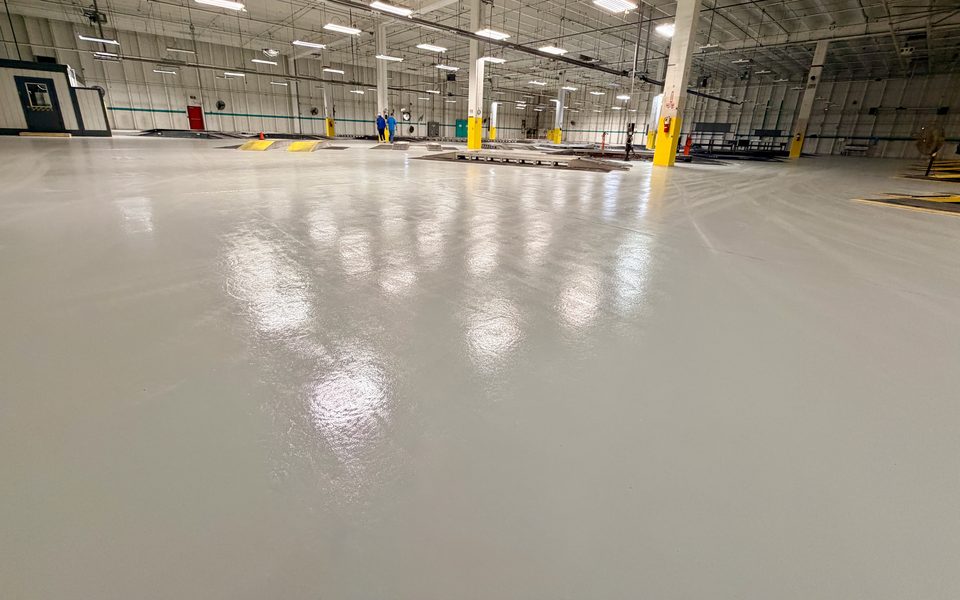
Epoxy floor coating installation in progress on one side of a Jacksonville warehouse during phased work
Can You Coat a Warehouse Without Shutting the Whole Thing Down?
Usually, yes — by phasing. The floor gets divided into sections, work is confined to one section at a time, and the rest of the building stays out of the dust and the schedule. With fast-cure polyaspartic top coats, a finished section can take forklift traffic again in about 24 hours. A single empty-building install is cheaper per square foot when the calendar allows it. It often doesn't, and phasing is the standard answer.
JaxPort is a fair example of how this goes in practice. The building wasn't fully operational at the time, and we ran the job in two phases: coat one side, cure it, move to the other. The side we weren't working on was never affected — no dust migration, no blocked access, no schedule coordination beyond agreeing which half was ours first. Two phases is the simplest version of this. In a fully operating distribution center the map gets more granular — sections follow how loaded racking can actually move, dock doors keep a working path to storage, and the hardest zones land on nights and weekends — but the principle is the same one JaxPort used: the work stays inside a boundary, and the operation stays outside it.
Two details make or break phased work. Vacuum-shrouded diamond grinding keeps concrete dust contained at the machine, so product in the next zone doesn't need shrink-wrapping. And cure chemistry sets the tempo: standard epoxy wants days per section, polyaspartic gives a section back in a day, and that difference compounds across every phase on the map.
What Floor Markings Does OSHA Expect?
OSHA is more specific about warehouse floors than most people expect. 29 CFR 1910.176(a) requires permanent aisles and passageways to be appropriately marked, and 1910.22 requires walking-working surfaces kept clean, orderly, and safe. In practice, an inspector walking a well-run facility expects to see striped forklift lanes, pedestrian walkways, staging boundaries, and clear zones at exits, electrical panels, and fire equipment.
The installation detail that matters: put the striping inside the coating system, between coats and under the final wear layer, not on top of the finished floor. Tape and surface paint sit in the traffic and forklifts eat them within months; striping under the wear coat typically lasts as long as the coat that protects it. Layout costs an hour of planning while the floor is bare, and it's the one moment striping is nearly free:
- Separate forklift lanes from pedestrian walkways with color, and route the walkways away from blind rack corners rather than along them.
- Mark staging footprints at receiving and shipping so the “temporary” pallet wall never colonizes an aisle.
- Box out battery charging, exits, electrical panels, and fire equipment with keep-clear zones.
- Put anti-slip aggregate where the floor actually gets wet — entries, wash zones, dock edges — and keep the pick aisles smoother so your scrubber can do its job.
The Returns That Never Show Up in the Quote
Nobody itemizes these in a bid, but they're a real part of the math. Bare concrete sheds fine dust continuously under traffic — it settles on product, works into HVAC filters, and acts as an abrasive under every tire and caster in the building. Sealing or polishing the surface ends that, and maintenance crews usually notice within the first month: scrubber passes replace sweeping-and-losing, and forklift tires stop wearing from the bottom up.
Lighting is the sleeper. A polished or light-gray coated floor reflects a meaningful share of overhead light back into the space; under 30-foot clear heights that reads as a visibly brighter building on the same fixtures. It's not a line item that pays the invoice by itself, but walk a customer or an insurance inspector across a bright, dust-free, striped floor and the impression is doing work for you.
Warehouse Floors We've Installed
- JaxPort Auto Repair Warehouse — 53,939 sq ft — moisture-control primer off the probe readings, grout coat, Resuflor non-skid top coat. Installed in two phases, one side at a time; the other side of the building was unaffected while we worked.
- AMPORTS Jacksonville — High-Performance Epoxy — Sherwin-Williams GP 3745 high-performance epoxy system across an industrial vehicle-processing warehouse.
- 30,000 sq ft Commercial Warehouse Polishing — 800-grit polish for a dry-goods floor plate. No film, no recoat cycle, forklift-rated.
- Manufacturing Facility Epoxy Flooring — 3,000 sq ft acid-resistant coating where process chemistry, not traffic, drove the spec.
Frequently Asked Questions
What's the best floor coating for a warehouse?
There isn't one, and that's not a dodge — it's zoning. Dry storage and traffic aisles usually want polished concrete, since there's no film for forklifts to wear through. Repair bays, charging areas, and wash zones want a coating, because there the film is the protection. Most of our warehouse projects install two systems, sometimes three, matched to what each zone does to the floor.
Do I really need moisture testing before coating?
In Florida, yes, every time. Slabs transmit water vapor whether or not they look wet, and a coating installed over unmeasured moisture blisters and peels, usually inside the first year and a half. ASTM F2170 probe testing typically costs a few hundred dollars and determines whether the system needs a mitigation primer. It's the least expensive insurance in the project.
How long does a warehouse floor take to install?
Rough rule: a 10,000 sq ft coated section runs about a week from grinding to full cure with standard epoxy, and fast-cure polyaspartic tops can take forklift traffic in about 24 hours. Polished concrete returns each area to service almost immediately behind the machines. Phased projects run longer end-to-end but never take the whole building offline at once.
Polished concrete or epoxy for a distribution center?
For open dry floor plates, polished concrete usually wins: nothing to delaminate, no recoat cycle, and the light reflectance is a genuine bonus under high ceilings. Epoxy earns its place where there's chemistry, moisture, or staining risk. Plenty of distribution centers polish 90% of the slab and coat the rest.
Which floor markings are actually required?
OSHA 1910.176(a) requires marked permanent aisles and passageways; 1910.22 covers keeping walking surfaces safe and orderly. Beyond the minimum, striped pedestrian lanes, staging boundaries, and keep-clear zones at exits and panels are what an inspector expects to see in a well-run facility. Striping installed inside the coating system, under the wear coat, outlasts tape by years.
ABOUT THE AUTHOR
Tony Guan, Ph.D., P.E. is the founder and owner of Advance Industrial Coatings. He is a licensed Florida Professional Engineer (license #72447) and SSPC QCS-certified coatings specialist, with engineering and field experience across commercial floor-coating and concrete-polishing installations in food processing, healthcare, manufacturing, and institutional facilities throughout Florida and the Southeast. For scope review or specification assistance, contact AI Coating directly.
Related Reading
Warehousing & Storage Flooring
Flooring systems for warehouses and distribution centers — forklift-rated coatings, dust-proofing, and line-marking solutions.
Continue reading →ProjectJaxPort Auto Repair Warehouse Floor Coating
53,939 sq ft warehouse floor with moisture-control primer and non-skid epoxy top coat, installed in two phases in Jacksonville FL.
Continue reading →BlogCommercial Epoxy Flooring Cost
Companion cost guide — installed pricing by system, what drives the quote spread, and 15-year total cost of ownership.
Continue reading →