Commercial Epoxy Flooring Cost in 2026: What Facility Managers Should Budget
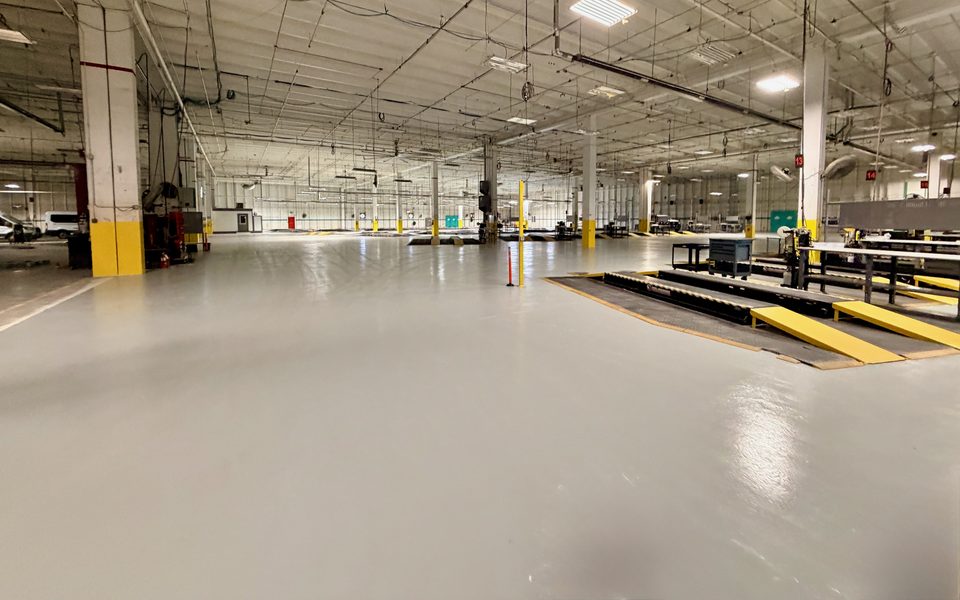
Completed 53,939 sq ft commercial warehouse epoxy floor coating with non-skid topcoat in JaxPort, Jacksonville FL
“What does commercial epoxy flooring cost?” is the question we get from facility managers, plant managers, and procurement teams before almost every project. Commercial epoxy quotes span roughly three to four times in dollar-per-square-foot — and the reasons for the spread are not arbitrary. System type, square footage, slab condition, prep depth, phasing, and facility category each move the number in ways that compound.
This guide is the breakdown we'd give a procurement team trying to set a budget before requesting quotes. It covers installed pricing by system, what drives the spread between low and high bids, the 15-year total cost of ownership math against alternatives, what information to have ready when calling contractors, and why commercial scopes are quoted differently than residential garage coatings.
How Much Does Commercial Epoxy Flooring Cost Per Square Foot?
Commercial epoxy flooring runs $3 to $15 per square foot installed, depending on system type, square footage, and concrete condition. A typical 10,000 sq ft warehouse high-build epoxy coating lands in the $50,000–$80,000 range installed. A 20,000 sq ft urethane mortar floor for a food plant runs $160,000–$300,000. Per-square-foot pricing drops as square footage rises — mobilization, prep equipment, and crew setup are largely fixed costs spread over more area.
The range that matters most for budgeting is the spread within a single system. Two warehouses asking for “high-build epoxy” can quote 30–40% apart on price for legitimate reasons — slab moisture levels, existing coating removal, joint repair, scheduling constraints. A quote far below the range below usually means corners are being cut on prep, mil thickness, or both. A quote far above the range usually reflects unusual site conditions, premium aesthetic finishes, or specialized chemical resistance requirements.
| System | Cost per sq ft | Best Commercial Use | Typical Project Size |
|---|---|---|---|
| Standard Epoxy (2-coat) | $3–$5 | Light commercial, retail back-of-house, dry storage | 2,000–10,000 sf |
| High-Build Epoxy (100% solids) | $5–$8 | Warehouses, manufacturing, distribution centers, auto repair | 5,000–50,000 sf |
| Polyaspartic / Polyurea | $5–$12 | Fast-turnaround facilities, retail open during install, restaurants | 2,000–15,000 sf |
| Urethane Mortar | $8–$15 | Food processing, breweries, dairy, commercial kitchens with hot washdown | 3,000–20,000 sf |
| Decorative Flake / Quartz Broadcast | $5–$9 | Showrooms, retail, healthcare corridors, locker rooms | 1,000–10,000 sf |
| Metallic Epoxy | $6–$12 | Hospitality lobbies, showrooms, branded retail | 1,000–5,000 sf |
For the full system-level breakdown — including prep methods, mil thickness, and cure times — see our commercial floor coating service overview. For regulated food and beverage environments where urethane mortar is the default, the USDA flooring guide covers compliance-driven specification.
What Factors Drive the Spread in a Commercial Epoxy Quote?
The five factors that move a commercial epoxy quote the most are square footage, existing slab condition, prep depth, system mil thickness, and facility constraints (phasing, occupancy, downtime). System type sets the baseline; these five factors decide where in the range you actually land.
1. Square footage
A 3,000 sq ft job and a 30,000 sq ft job cost very different per-square-foot prices even with the same system spec. Mobilization, equipment rental, surface prep tooling, and crew setup are largely fixed costs. A two-day mobilization spread over 3,000 sq ft adds $1.50–$2.00/sq ft; the same mobilization over 30,000 sq ft adds $0.15–$0.20/sq ft. This is why small commercial jobs frequently price higher than industrial-scale jobs on the same system.
2. Slab condition
The largest single cost driver we see in the field is concrete condition. A clean, sound slab takes a coating directly with diamond-grinding prep. A slab with moisture-vapor transmission issues, old failed coatings, ASR cracking, oil contamination, or significant unevenness can add $1–$3 per square foot in prep, moisture mitigation, crack repair, or self-leveling underlayment. We test every slab for moisture content and emission rate before specifying a system — uncontrolled moisture is one of the most common causes of premature coating failure in commercial work. On the JaxPort 53,939 sq ft auto repair warehouse, the spec opens with a Resuprime moisture-control primer before the Resuflor grout and non-skid topcoat — a deliberate choice driven by the slab's moisture profile, not a default for every warehouse floor.
3. Prep depth
Surface profile drives bond. CSP-2 (light broom-finish profile) is fine for thin coatings; CSP-3 through CSP-5 is required for high-build epoxy and mortar systems. Achieving deeper profile means heavier grinding, sometimes shot-blasting, and slower production. A quote that hits the floor of the range usually assumes light prep; a quote that lands mid-range typically includes proper profile, joint repair, and moisture vapor primer where called for. If a contractor doesn't describe their prep method, that's a meaningful gap in the scope — prep is half of what you're paying for.
4. Mil thickness and number of coats
A “two-coat epoxy” can mean 8 mils total or 25 mils total depending on the product and the installer. High-build epoxy at 20–30 mils costs more in material and labor than a thin 2-coat system at 8–12 mils — and lasts substantially longer under commercial traffic. For warehouse, manufacturing, or auto-service environments, anything thinner than a high-build 100% solids system tends to wear through in 3–5 years in forklift wheel paths. The cheaper quote often costs more over a 10-year horizon.
5. Facility constraints
Working in an occupied facility — staging, phasing, weekend or overnight installs, containment between work areas — adds real cost. A 24-hour install window in a single 50,000 sq ft warehouse is a different job from the same square footage installed in eight 6,000 sq ft phases on weekends over two months. The latter typically runs 25–40% more, but for an operation that can't afford a full shutdown, that's usually still cheaper than lost production. We design phasing around the facility's sanitation, production, or operating schedule rather than ours.
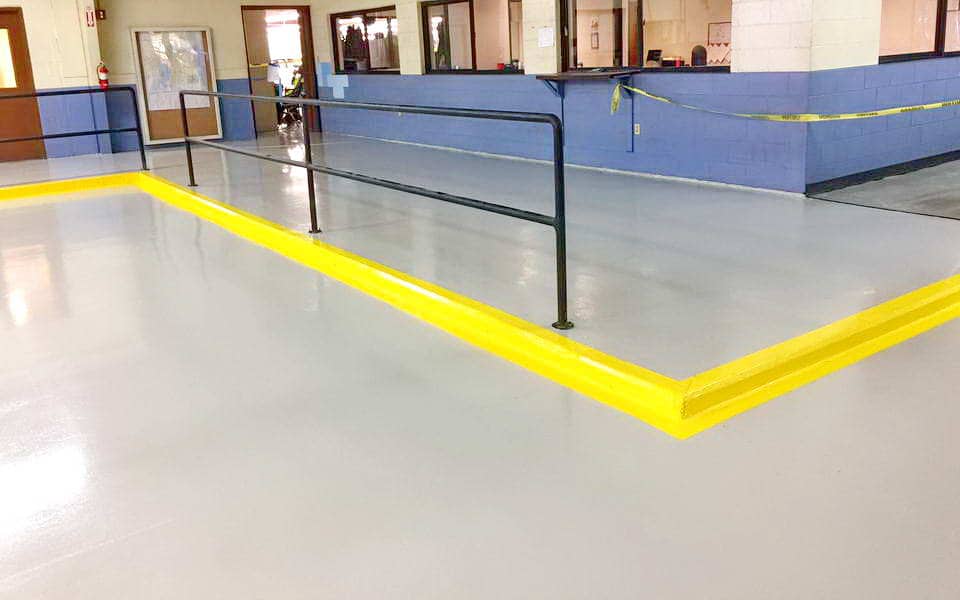
High-performance epoxy floor coating at AmPorts Jacksonville industrial facility
Is Commercial Epoxy Worth the Investment? 15-Year Cost-of-Ownership
Over a 15-year facility horizon, commercial epoxy is often lower total cost of ownership than paint or VCT in environments where chemical resistance, slip texture, color, or designed safety markings matter. A $60,000 high-build epoxy floor for a 10,000 sq ft warehouse works out to $0.40 per square foot per year over a 15-year service life. Repainting the same slab every 2–3 years runs $0.70–$1.00/sq ft per year before counting downtime to do it. (As the table below shows, polished concrete posts an even lower annualized number where it's a viable spec — chemical exposure, color, and slip-texture requirements are what push facilities toward epoxy.)
| Flooring Approach | Initial Cost (10,000 sf) | Service Life | Annualized Cost / sq ft | 15-Year Total |
|---|---|---|---|---|
| High-Build Epoxy (Commercial) | $50,000–$80,000 | 12–15 years | $0.35–$0.55 | $55,000–$85,000 |
| Urethane Mortar (Food/Wet) | $80,000–$150,000 | 15–20+ years | $0.40–$0.75 | $85,000–$155,000 |
| Paint / Sealed Concrete | $10,000–$30,000 | 1–3 years | $0.70–$1.50 | $110,000–$225,000 |
| VCT (Vinyl Composition Tile) | $10,000–$40,000 | 5–10 years (with strip/wax) | $0.65–$1.10 | $95,000–$165,000 |
| Polished Concrete (Commercial) | $20,000–$60,000 | 20+ years | $0.15–$0.30 | $25,000–$70,000 |
The 15-year numbers above include reinstall, recoat, or refinish costs at end-of-service-life and routine maintenance — they do not include the soft costs that decide most commercial flooring debates: downtime for reinstall, lost product to dust from a deteriorating slab, increased forklift tire wear from a rough surface, or compliance exposure in regulated environments.
Polished concrete posts the lowest annualized cost in the table above and is often the right answer for big-box retail, warehouse, and offices where chemical resistance isn't the driver. Epoxy wins where chemical resistance, color, slip texture, or designed safety markings matter. Urethane mortar wins where steam, hot washdown, and aggressive cleaning chemistry are part of the cycle. We've written the long-form comparison in our concrete polishing service overview.
Need a Realistic Budget Number Before You Issue an RFP?
We'll review your facility, slab condition, traffic profile, and operating constraints and give you a budget range you can take to procurement. No high-pressure quote, no obligation. Licensed Florida Professional Engineer on staff. Serving Jacksonville, Orlando, Tampa, and the Southeast.
How to Get an Accurate Commercial Epoxy Flooring Quote
An accurate quote depends on accurate inputs. The five pieces of information that move a quote from a rough number to a firm budget are square footage, current floor condition, facility type and traffic profile, schedule and downtime constraints, and any special performance requirements. The faster you can put these in front of a contractor, the faster you get a meaningful number.
What to have ready before you call
- Total square footage — net coated area, not gross building. Include cove base linear feet separately if applicable.
- Slab age and condition — original pour date if known, any existing coating, visible cracks, low spots, or signs of moisture (efflorescence, stained perimeter).
- Facility type and traffic — forklift weight class, pallet jacks, foot traffic only, hot-tire pickup on car traffic, chemical exposure inventory.
- Operating schedule — full shutdown available, phased work required, weekend-only access, or 24-hour turnaround needed.
- Performance requirements — chemical resistance list, USDA/FDA compliance, anti-static, slip resistance target, color or safety striping needs.
Red flags in commercial flooring quotes
We've been called to remediate enough failed coatings to know the warning signs in a quote. The patterns repeat:
- No mention of prep method — “clean and coat” without specifying CSP profile, grinding vs shot-blasting, or moisture testing. Prep is half the project; if it's not in the scope, it's not in the price.
- No mil thickness specified — a “two-coat epoxy” with no mil callout can be anything from a $1.50/sq ft thin film to a $6/sq ft high-build system.
- No moisture testing — on any commercial slab over a few years old, especially in Florida humidity, moisture vapor emission rates need to be measured. A coating installed over an unmeasured slab is a coin flip on bond integrity.
- No warranty terms or vague warranty language — a 1-year written warranty on materials and labor that names specific failure modes (delamination, blistering, peeling) is the realistic baseline. A 10- or 15-year warranty number with no fine print usually means a pro-rated or narrowly scoped document, not extra coverage.
- No manufacturer certification or proof of insurance — current applicator certifications (Sherwin-Williams, BASF, Dur-A-Flex, General Polymers) and general liability + workers' comp coverage are baseline for commercial work. Confirm both before signing.
Why Does Commercial Epoxy Cost More Than a Residential Garage Coating?
Commercial scopes cost more in total than residential garage coatings, and require different materials, prep standards, crew size, insurance, and warranty exposure — but per-square-foot pricing depends on size, system, and downtime constraints. On a large, single-shutdown commercial floor, the per-sf rate can land surprisingly close to a small residential garage job. The bigger differences are scope and documentation: a garage coating is typically a 1–2 day, 2-person, consumer-grade install; a commercial install is a multi-day, multi-crew, engineered system with documented performance specs and warranty obligations.
Commercial-grade materials
Most residential garage products are 70–90% solids polyaspartic or two-part epoxies optimized for fast cure and low-odor application in occupied homes. Commercial systems use 100% solids epoxies, urethane mortars, MMAs, and resinous chemistries designed for sustained chemical exposure, thermal cycling, and forklift-rated abrasion. The material itself runs 2–3x the per-gallon cost of consumer products.
Surface prep standards
Residential garage prep is often acid etching or light grinding to CSP-1 or CSP-2. Commercial prep is diamond grinding or shot-blasting to CSP-3 through CSP-5, with documented moisture testing, joint repair, and primer compatibility checks. Prep equipment alone — planetary grinders, dust extraction, shot-blast machines — runs $40,000–$150,000 in capital before the first project.
Crew size and insurance
A garage job is two people for a day. A 20,000 sq ft commercial install is a 4–6 person crew for a week, plus OSHA-compliant containment, signage, fall protection where applicable, and full general liability and workers' comp coverage. Commercial bonding and insurance requirements for any meaningful facility add measurable overhead per project.
Warranty and accountability
Standard commercial warranty terms are narrower than most marketing copy suggests. Our typical warranty is 1 year on materials and labor; many manufacturers also cover their product for about 1 year. The reason isn't cynical — it matches how these systems actually fail. If a coating is going to fail, it typically fails inside the first year, and early failures are usually installation- or substrate-related: missed moisture, inadequate profile, wrong primer, contaminated substrate. A floor that survives year one typically lasts 10–20 years before it needs significant intervention. If you see a quote with a 10- or 15-year written warranty, read the fine print — it's usually pro-rated, narrowly scoped, or tied to maintenance conditions the facility won't actually meet.
Recent Commercial Epoxy Projects — Specs & Scale
Selected commercial epoxy installations completed by AI Coating. Each shows the system specified, square footage, and the operating constraint that drove the spec — so you can calibrate against similar projects in your facility category.
- JaxPort Auto Repair Warehouse — 53,939 sq ft — 3-coat Resuprime moisture control primer, Resuflor 3746 grout coat, Resuflor 3746 non-skid topcoat. Diamond-ground prep with concrete patching and substrate vacuum cleaning before each coat. Specified for forklift and lift-cart traffic in an auto repair environment.
- AmPorts Jacksonville — High-Performance Industrial Epoxy — Industrial-grade epoxy system for a port facility. Heavy equipment traffic, hydrocarbon exposure, and outdoor-adjacent conditioning.
- Public Storage — Random Flake Epoxy — Decorative random-flake epoxy across self-storage corridors and units. Aesthetic finish with commercial-grade durability for daily customer traffic.
- USDA/FDA Compliant Commercial Kitchen — Jacksonville — Urethane mortar system with integrated cove base for a high-volume commercial kitchen. Specified for hot washdown, grease resistance, and health-department compliance.
Frequently Asked Questions
What’s the cheapest commercial epoxy option that still holds up?
For dry-storage warehousing, light-traffic back-of-house, or packaging areas without chemical exposure, a properly installed high-build 100% solids epoxy at 12–15 mils total runs $5–$6/sq ft and typically holds up 8–12 years. Going below that — into thin-film or paint-style epoxies — often costs more over a 5-year horizon because you’re recoating every 2–3 years. The cheapest viable commercial system is rarely the cheapest sticker price.
How accurate is a quote based on square footage alone?
Within about ±30%, for a known facility category and system type. A ballpark over the phone — “20,000 sq ft warehouse, high-build epoxy” — is enough to give you a budget range. Tightening that to a firm number requires a site visit: slab condition, moisture testing, existing coating assessment, and an honest look at the operating schedule. We do site visits at no cost for commercial scopes in our service area.
Does the cost go down for larger projects?
Per square foot, yes — substantially. A 5,000 sq ft job and a 50,000 sq ft job on the same system can differ by $1.00–$2.00/sq ft. Mobilization, equipment rental, and crew setup are largely fixed costs. The break point we see most often is around 10,000 sq ft, where the fixed costs start dropping below 15% of the total.
Can we coat the floor without shutting down operations?
Usually yes, with phased installation and the right system choice. Polyaspartic and MMA systems cure in hours rather than days, which fits weekend or overnight windows. High-build epoxy in an occupied facility usually runs as a phased install — sectioning off 3,000–5,000 sq ft at a time with temporary containment. Expect a 25–40% premium for phased work versus a single shutdown window. For most operations, that premium is much smaller than the cost of lost production days.
How long is the typical warranty on a commercial epoxy floor?
Our standard warranty is 1 year on materials and labor, and many manufacturers cover their product for roughly 1 year as well. That timeframe isn’t a hedge — it matches how these systems fail. Early coating failures are usually installation- or substrate-related (moisture not measured, wrong primer, inadequate surface profile, contaminated substrate), and they tend to surface inside the first year. A floor that makes it through year one typically lasts 10–20 years before it needs significant work. If a competitor offers a 10- or 15-year written warranty, read the fine print: it’s usually pro-rated, narrowly scoped, or tied to maintenance conditions the facility won’t actually meet. Ask whether coverage is installer-only, material-only, or manufacturer-backed, and whether the install requires applicator certification (Sherwin-Williams, BASF, Dur-A-Flex, General Polymers, etc.) to be valid.
Do you serve commercial projects outside Jacksonville?
Yes. AI Coating serves commercial and industrial facilities across Jacksonville, Orlando, Tampa, and the broader Florida and Southeast region — warehouses, distribution centers, food and beverage processing, healthcare, manufacturing, retail, and government work.
ABOUT THE AUTHOR
Tony Guan, Ph.D., P.E. is the founder and owner of Advance Industrial Coatings. He is a licensed Florida Professional Engineer (license #72447) and SSPC QCS-certified coatings specialist, with engineering and field experience across commercial floor-coating and concrete-polishing installations in food processing, healthcare, manufacturing, and institutional facilities throughout Florida and the Southeast. For scope review or specification assistance, contact AI Coating directly.
Related Reading
Commercial Floor Coating Services
System overview, prep standards, and what we install across warehouse, manufacturing, food processing, and healthcare facilities.
Continue reading →BlogUSDA Compliant Flooring for Food Processing
Companion guide on regulated environments — what USDA and FDA actually require and why urethane mortar dominates wet-process plants.
Continue reading →BlogEpoxy Mortar & Urethane Mortar Systems
Technical primer on mortar chemistries — when each is specified and why thicker isn't always better.
Continue reading →