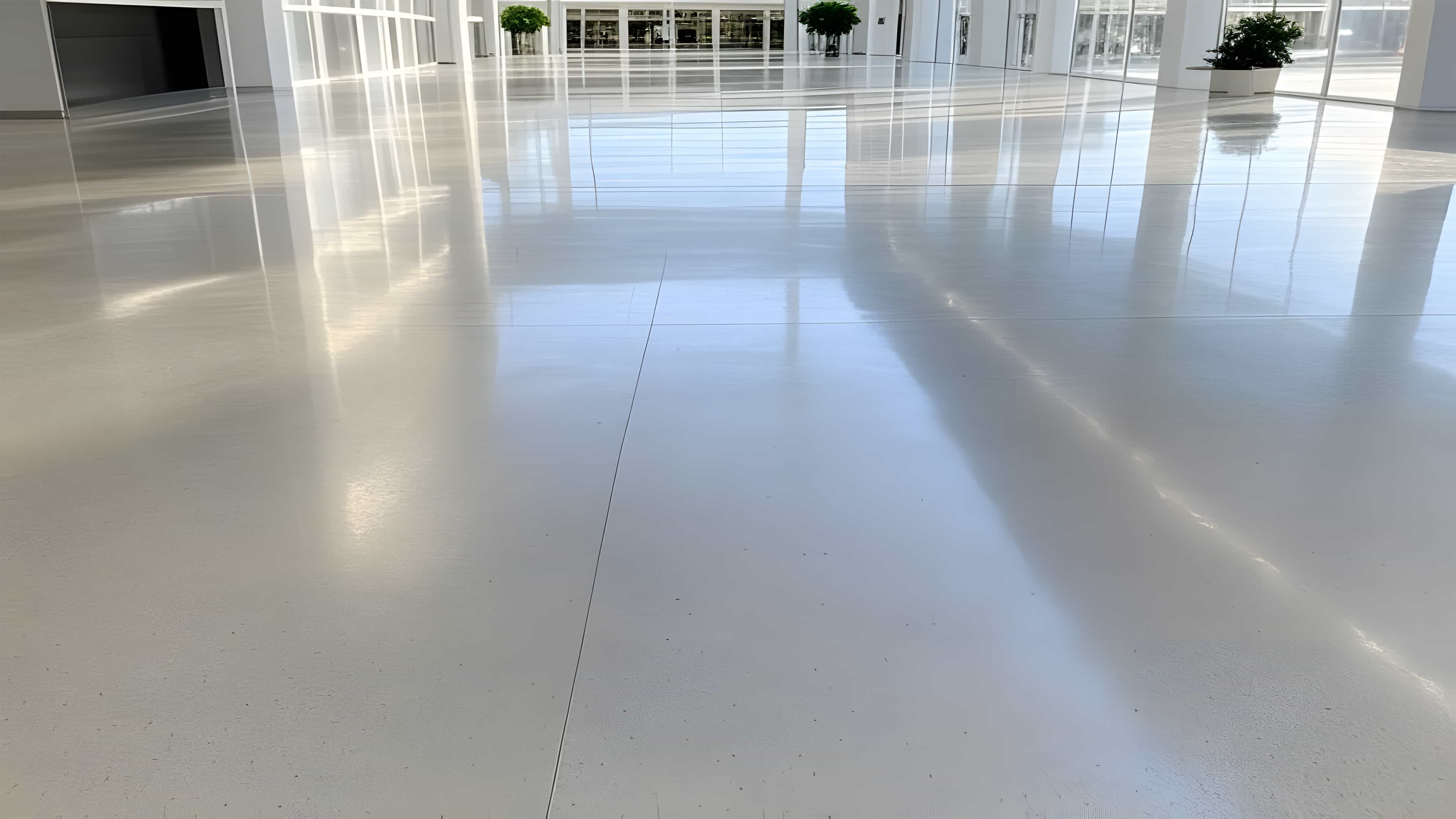
USDA Compliant Flooring: What Food Processing Facilities Need to Know
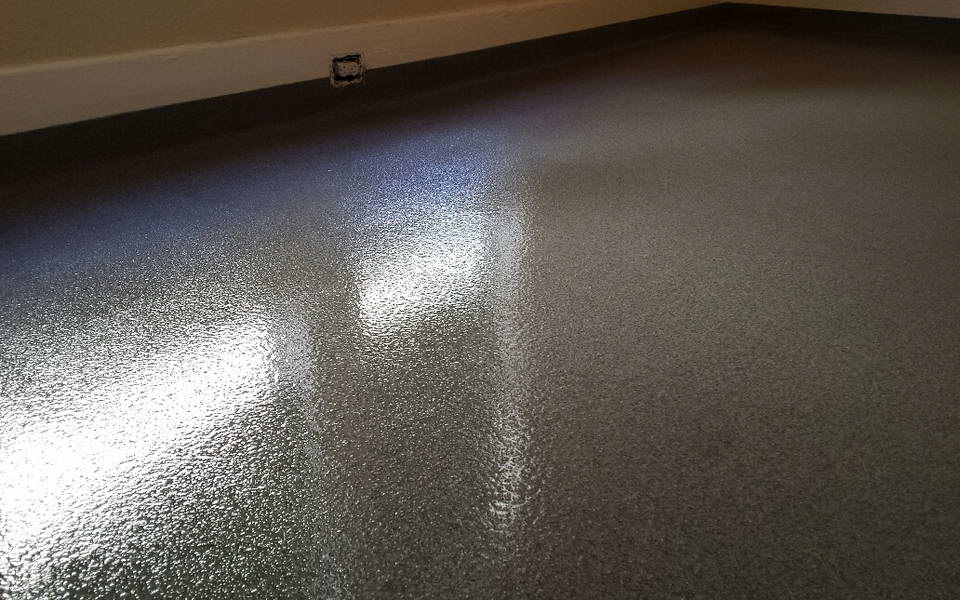
Trowel-applied quarter-inch urethane mortar floor installation for a commercial food-service facility
Flooring in a meat plant, dairy, brewery, or commercial kitchen is a sanitation surface before it's anything else. It has to hold up under hot washdown, caustic cleaners, acids, grease, and mechanical traffic — and it has to do it without trapping soil, water, or pathogens in cracks and joints. USDA inspectors, FDA auditors, and state health departments all look at flooring condition in routine inspections.
This guide covers what the federal regulations actually say, which coating systems are typically used to meet those standards, what they cost installed, and how to tell whether an existing floor is putting a facility at inspection or food-safety risk.
What Flooring Does USDA Require for Food Processing Facilities?
For USDA-inspected plants, the federal flooring requirement is simpler and stricter than most product brochures make it sound: floors must be durable, moisture-impervious, cleanable, sanitary, and kept in good repair. In wet process rooms, a seamless resinous system with integrated cove base is usually how facilities meet that standard — but the product label alone does not make the floor compliant.
There is no off-the-shelf “USDA-approved floor” you can buy. USDA doesn't pre-approve specific products. The governing language for meat, poultry, and egg-product establishments is 9 CFR 416.2(b)(2), which requires floors constructed of durable, impervious-to-moisture materials that can be readily cleaned; drainage is covered separately under 9 CFR 416.2(e)(4). FDA-regulated food plants fall under 21 CFR 117.20(b)(4) (Current Good Manufacturing Practice, modernized in 2015 from the older 21 CFR 110), which requires cleanable, well-maintained floors, walls, and ceilings. A product marketed as “USDA compliant” only stays compliant if it's specified, installed, and maintained correctly for the specific environment.
What the practical compliance checklist looks like:
The regulations themselves are performance-based. In practice, inspectors and sanitation consultants look for a consistent set of conditions in wet processing areas:
- Surface is cleanable and non-absorbent — no exposed concrete, no open pores, no worn areas trapping moisture or soil.
- Chemical tolerance for the caustic detergents, acid rinses, and sanitizers used in Clean-in-Place (CIP) and Clean-out-of-Place (COP) regimes.
- Slip resistance under wet conditions — typically evaluated against ASTM or ANSI A326.3 methods.
- No cracks or joints that trap soil or moisture — open cracks and failing joints show up as sanitation findings.
- Wall-to-floor junction sealed cleanly — most operators run an integrated coved base because a caulked or grouted joint tends to fail under repeated washdown.
- Thermal tolerance for hot water or steam washdown where that's part of the sanitation cycle.
Systems that meet these conditions reliably fall into four families: urethane mortar, epoxy mortar, seamless resinous coatings (epoxy with a polyurethane or polyaspartic topcoat), and MMA for fast-turnaround environments. See our commercial floor coating services page for the full system overview.
What Happens If Your Food Processing Floor Doesn't Meet USDA Standards?
Sanitation findings in flooring show up as FSIS Noncompliance Records (NRs), and repeated or serious noncompliance can escalate to regulatory action up to suspension or withdrawal of inspection. The separate food-safety exposure is potentially larger: porous or failing floors can contribute to harborage conditions for Listeria, Salmonella, and other pathogens, and recall and liability costs for a single contamination event routinely exceed the cost of the floor itself by a wide margin.
USDA FSIS inspectors document sanitation findings as Noncompliance Records. When we're called in to assess an existing floor, the flooring-linked findings we see most often fall into a short list: worn coatings in forklift wheel paths where the topcoat has ground away to bare concrete, standing water in low spots where the slab has settled since original pour, and wall-to-floor cove that's debonded at the vertical run where caulk or grout has eroded under repeated washdown. One or two NRs on their own are not unusual and not a crisis. What matters to FSIS is pattern: repeated findings, uncorrected conditions, or systemic sanitation failures are what drive escalation.
In more serious cases — typically after repeat findings or when a condition is tied to a positive pathogen sample — FSIS can move to a Notice of Intended Enforcement and, ultimately, to suspension or withdrawal of inspection. Without active inspection, USDA-regulated product cannot legally enter commerce. Even a short suspension costs a mid-size processor days of production and recovery effort with customers.
On the food-safety side, porous concrete, failed coatings, and cracked floor-to-wall junctions are known harborage candidates for Listeria and other environmental pathogens — floors and drains are standard targets in environmental monitoring programs for a reason. A single recall linked to contamination commonly runs into the millions once you account for product destruction, logistics, legal exposure, insurance impact, and lost business. A seamless, well-installed urethane mortar floor for the same space costs a small fraction of that number.
How Much Does USDA Compliant Flooring Cost?
Compliant floor systems for food processing generally run $6 to $15 per square foot installed, depending on the system and the facility. Urethane mortar is typically $8 to $15 per square foot and is the default in heavy-washdown rooms. Epoxy mortar runs $6 to $12 per square foot. Seamless resinous coatings run $4 to $8 per square foot for lighter-duty applications. A 10,000 sq ft meat-processing floor usually installs somewhere in the $80,000 to $150,000 range, including coved base and drainage integration — with the spread driven mostly by slab condition and phasing.
| System | Cost per sq ft | Typical Use | Lifespan |
|---|---|---|---|
| Urethane Mortar | $8–$15 | Meat & poultry, dairy, breweries, commercial kitchens with hot washdown | 15–20+ years |
| Epoxy Mortar | $6–$12 | Food prep, lighter production, packaging with moderate chemical exposure | 10–15 years |
| Seamless Resinous (Epoxy + Topcoat) | $4–$8 | Dry storage, packaging, bakeries, lower washdown areas | 7–12 years |
| MMA (Methyl Methacrylate) | $8–$14 | Cold storage, facilities needing return-to-service in hours not days | 10–15 years |
The cost question that matters more than per-square-foot pricing is total cost of ownership. A $12/sq ft urethane mortar floor with a 20-year service life works out to $0.60 per square foot per year. A $3/sq ft sealed-concrete approach that needs resealing and patching every 18–24 months — and often struggles to stay in compliance as it wears — is more expensive in practice, before you include a single inspection finding or food-safety incident.
Major cost drivers beyond system type: existing slab condition, demolition of old failed coatings, drainage and trench work, integrated stainless-steel cove base hardware, phased installation around production schedules, and any moisture mitigation required under the coating. We test every slab for moisture content and vapor emissions before specifying a system — uncontrolled moisture is the most common cause of premature coating failure in food processing environments.
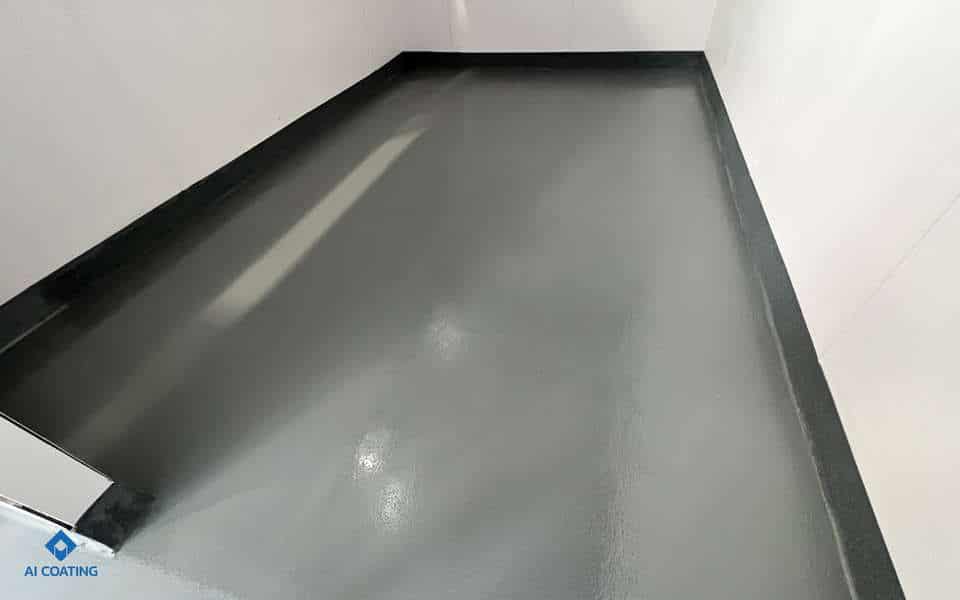
Completed commercial kitchen urethane mortar floor with seamless integrated cove base
Why Urethane Mortar Is the Default for Wet-Process Food Plants
For heavy-washdown areas — meat, dairy, breweries, high-volume kitchens — urethane mortar is the workhorse system. It tolerates hot water and steam cleaning at 180°F and above without thermal-shock damage, resists the caustics and sanitizers used in CIP and COP, and installs as a trowel-applied, monolithic quarter-inch layer with an integrated cove base. Return to service is typically 12 to 24 hours depending on thickness, product, and temperature.
Thermal shock performance
A meat-plant floor may cycle from ambient to a 180°F+ hot-water wash, then to a cold rinse, several times a shift. Standard epoxy coatings tend to craze, crack, or delaminate under repeated cycling at those temperatures. Urethane mortar's composite structure — urethane polymer, cement, and graded aggregate — expands and contracts closer to the concrete substrate beneath it, so it holds up through thermal cycling that shortens the life of a pure resin coat. That thermal tolerance is the single largest reason operators keep specifying urethane mortar in meat, dairy, and brewery work.
Chemical resistance
The chemistry stack in food sanitation is aggressive: caustic detergents, chlorinated alkaline cleaners, acid rinses, quaternary ammonium sanitizers, peroxyacetic acid (PAA). Urethane mortar handles that stack at commercial concentrations and at elevated temperatures. Epoxy systems are competitive at room temperature but lose performance when you add heat.
Integrated cove base
The wall-to-floor junction is one of the most common harborage points in a wet processing room — caulked, grouted, or tiled joints tend to degrade under repeated washdown. Urethane mortar can be coved up the wall 4 to 6 inches as a continuous extension of the floor, so there's no joint to fail. Inspectors and sanitarians look closely at that junction; a continuous cove that's still intact years into service life is a strong visible compliance signal.
The second-most-common cove failure we see in audits isn't the mortar itself — it's the vertical run debonding from a wall that wasn't prepped. The horizontal floor bonds fine, but the cove separates at the top because the wall surface wasn't profiled or primed for the mortar chemistry. Inspectors notice the gap. Specifying wall prep as part of the scope — not just floor prep — is what keeps the cove compliant long-term.
Slip resistance
Urethane mortar is specified with aggregate broadcast to hit slip-resistance targets for wet environments. The texture level is tunable at spec time — more aggressive in wet process rooms, smoother in packaging and drier areas where cleanability matters more than grip.
In our food and beverage work across Florida, urethane mortar is usually the specified system where hot washdown is part of the sanitation cycle. Epoxy mortar or a heavy-duty resinous system takes over when chemical and abrasion resistance are the drivers but steam and thermal cycling aren't. The decision usually comes down to what cleaning regime the plant actually runs, not the product brochure.
Which Food & Beverage Facilities Need This Kind of Flooring?
Food and beverage facilities need flooring that matches the sanitation rules for their actual jurisdiction and process. USDA FSIS applies to meat, poultry, and egg-product establishments. FDA rules (21 CFR Part 117) cover most other food manufacturers. Commercial kitchens and foodservice operations are typically governed by state or local health departments, which adopt their own variants of the FDA Food Code. Seafood runs under its own HACCP regulation, and some alcohol-only operations fall outside FDA Part 117 entirely. In practice, wet processing, hot washdown, grease, acids, and drain layout drive the flooring specification far more than the agency name on the inspection form.
- Meat and poultry processing — USDA FSIS inspected. Urethane mortar is the common choice because of blood, fat, hot washdown, and thermal cycling.
- Dairy processing — similar duty cycle to meat: aggressive washdown, thermal swings, acidic byproducts from milk and whey.
- Breweries and distilleries — sugars, yeast, organic acids. Hot washdown and high ambient humidity typically push the spec toward urethane mortar, though not every brewery is under FDA Part 117 depending on product scope.
- Commercial bakeries and confectionery — lower thermal shock, but high traffic, dropped dough and batter, and frequent alkaline cleaning.
- Cold storage and frozen food — MMA systems often fit because they cure at low temperatures and return to service in hours, which matters when you're phasing work in a freezer.
- Commercial kitchens, catering, and institutional foodservice — usually under state or local health department jurisdiction rather than direct USDA/FDA inspection. Hot washdown and grease drive the specification regardless.
- Seafood processing — seafood HACCP (21 CFR Part 123) governs, with its own sanitation language. Salt, chlorine, and high-pressure washdown are the design drivers.
- Food packaging and distribution — less chemical exposure, but still needs a cleanable, well-maintained surface; often spec'd as a seamless resinous coating rather than a full mortar system.
- Pet food and animal feed manufacturing — jurisdiction varies (USDA, FDA, state) depending on product and species. Floor requirements parallel the human food side.
See our food & beverage industry page for the systems and specifications we run in each of these environments.
Urethane Mortar vs Epoxy vs Sealed Concrete for Food Processing
Urethane mortar leads on thermal shock tolerance, service life, and heaviest chemical exposure. Epoxy systems are competitive on chemical resistance at lower installed cost but tend to lose performance under sustained hot-steam washdown. Sealed or painted concrete can look fine on day one but generally becomes difficult to keep compliant in wet processing areas — the sealer wears, the slab cracks, water sits in low spots, and sanitation findings accumulate.
| Criterion | Urethane Mortar | Epoxy Mortar | Resinous Epoxy | Sealed Concrete |
|---|---|---|---|---|
| Suitable for wet-process food areas when properly specified | Yes | Yes | Yes (most systems) | Rarely suitable for wet processing |
| Steam / hot washdown tolerant (180°F+) | Yes | Limited | Generally not — degrades with repeated cycles | No |
| Chemical resistance (caustics, acids, sanitizers) | Excellent | Excellent | Very Good | Poor |
| Typical service life | 15–20+ years | 10–15 years | 7–12 years | 1–3 years |
| Cost per sq ft installed | $8–$15 | $6–$12 | $4–$8 | $1–$3 (repeated) |
| Integrated cove base | Standard | Yes, with specification | Yes, with specification | Not possible |
| Best fit | Meat, dairy, breweries, commercial kitchens | Lighter-duty food prep and packaging | Dry storage, bakeries, low-washdown areas | Non-food-contact zones only |
Planning a USDA-Compliant Floor for Your Food Processing Facility?
Get a scope review from a licensed Florida Professional Engineer with commercial food-facility experience. We specify and install urethane mortar, epoxy mortar, and seamless resinous systems for meat processing, dairy, breweries, and commercial kitchens across Jacksonville, Orlando, and the Southeast.
Our Food Processing & Commercial Kitchen Projects
Selected food-facility and commercial-kitchen installations completed by AI Coating, using systems suitable for USDA, FDA, and health-department requirements when properly specified. Each project includes the system used and the operational constraints driving the specification.
- Commercial Restaurant Kitchen — Urethane Mortar — seamless urethane mortar with integrated cove base for a high-volume commercial kitchen requiring hot washdown compatibility and grease resistance.
- Trowel-Applied 1/4" Urethane Mortar — Tampa Commercial Kitchen — Sherwin-Williams GP Fastop M urethane mortar system, diamond-ground substrate prep with crack repair and joint filling before the monolithic 1/4-inch mortar application.
Frequently Asked Questions
Can polished concrete be used as USDA-compliant flooring?
Generally not in wet-process areas of USDA-inspected facilities. Polished concrete is smooth and durable, but even after lithium silicate densification the substrate keeps some surface porosity, and a continuous coved wall-to-floor transition — the usual practical solution for sanitation — isn't part of a polished concrete system. Polished concrete also loses performance under repeated CIP chemicals and hot washdown. It's a reasonable specification for dry-process areas — warehousing, offices, packaging of pre-sealed product — and a poor one for process rooms, kill floors, prep areas, or any zone under washdown.
Is there a specific “USDA approved” floor coating product?
No. USDA does not pre-approve specific floor coating products. Compliance is determined by whether the installed system meets the performance standards — 9 CFR 416.2(b)(2) for USDA FSIS meat and poultry plants, and 21 CFR 117.20(b)(4) for FDA-regulated food manufacturers. Any vendor claiming their product is “USDA approved” is overstating the regulatory framework. What matters is correct system selection, proper installation, and ongoing maintenance.
Can urethane mortar be installed in an operating facility?
Yes, in phased sections. Most meat, dairy, and brewery installations happen in operational plants with production running on the other side of a temporary containment wall. Urethane mortar typically cures to walk-on in 12 hours and to full service in 24, which allows for weekend and overnight turnarounds. We plan phasing around your CIP and sanitation schedule.
Does USDA-compliant flooring need to be installed by a licensed contractor?
There is no federal license requirement specific to flooring installation, but a poorly installed compliant system is the same as a non-compliant system once it fails. Look for contractors with current manufacturer certifications (e.g., Dur-A-Flex, General Polymers, Sherwin-Williams, BASF), SSPC QCS or NACE coating qualifications, and demonstrable experience in food processing environments specifically. Many failed installations trace back to contractors whose experience was residential or light-commercial.
How long does a USDA-compliant floor installation take?
Urethane mortar over prepared concrete typically installs at 2,000–4,000 sq ft per day of crew time, including cove base. A 10,000 sq ft floor runs three to five production days plus prep and cure. MMA systems run faster — full cure in 1–2 hours — and are often the right choice when facility downtime is the limiting constraint.
Do breweries need USDA-compliant flooring, or just FDA?
Breweries fall primarily under FDA food-safety rules rather than USDA (USDA FSIS covers meat, poultry, and egg products); the TTB regulates the alcohol side separately. The regulatory frameworks aren't identical, but the practical flooring demands are often similar: hot washdown, organic acids from wort and yeast, wet traffic, and cleanable wall-to-floor transitions. Urethane mortar is a common choice for both craft and production brewery work.
Do you serve food processing facilities outside Jacksonville?
Yes. AI Coating serves commercial and industrial food facilities across Jacksonville, Orlando, Tampa, and the broader Florida and Southeast region. We've installed resinous and urethane mortar systems suitable for USDA, FDA, and health-department requirements in meat processing, commercial kitchens, breweries, and institutional foodservice environments throughout the state.
ABOUT THE AUTHOR
Tony Guan, Ph.D., P.E. is the founder and owner of Advance Industrial Coatings. He is a licensed Florida Professional Engineer (license #72447) and SSPC QCS-certified coatings specialist, with engineering and field experience across commercial floor-coating and concrete-polishing installations in food processing, healthcare, manufacturing, and institutional facilities throughout Florida and the Southeast. For scope review or specification assistance, contact AI Coating directly.
Related Reading
Food & Beverage Flooring
Systems, specs, and compliance considerations for food processing, breweries, and commercial kitchens.
Continue reading →BlogEpoxy Mortar & Urethane Mortar Systems
Technical primer on mortar chemistries — thermal shock, chemical resistance, and when to specify each.
Continue reading →BlogHealthcare Facility Flooring
Compliance-heavy flooring for another highly regulated environment — infection control parallels food processing.
Continue reading →